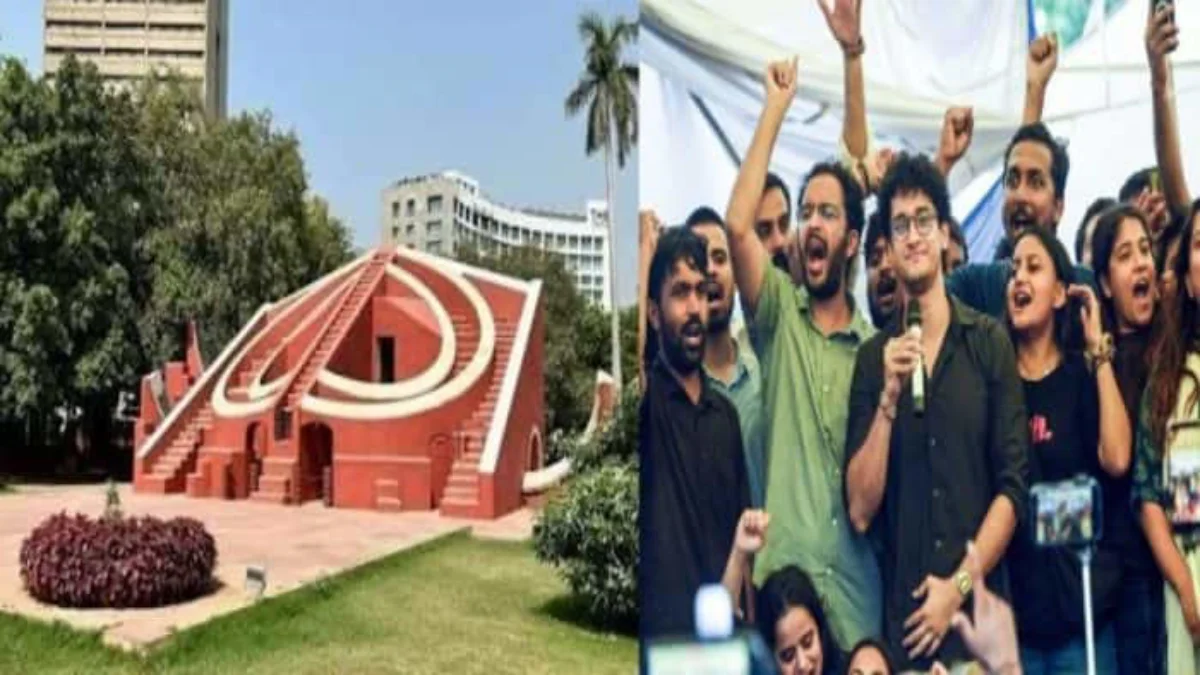
New Delhi: Built in 1724 to observe the movement of the sun, the moon and stars, Delhi’s Jantar Mantar became the address of India’s biggest youth movement in 2026. The Gen Z protest over the country’s examination system added another chapter to the long public life of a monument that has, over the past three decades, become the capital’s best-known address for protests.
What began as a satirical online campaign in the form of the Cockroach Janata Party (CJP) soon turned into one of the largest youth-led movements seen in the city in recent years. Thousands of students gathered at Jantar Mantar during the 49-day agitation, demanding accountability over paper leaks, examination reforms and the resignation of then Union Education Minister Dharmendra Pradhan. The protest ended after Pradhan stepped down and the Centre accepted all demands, including exam reforms and the withdrawal of cases against protesters.
The agitation has ended, but it has joined a long list of public movements that have passed through Jantar Mantar. Long before students arrived with placards demanding fair examinations, the same stretch of road had witnessed farmers, ex-servicemen, teachers, contract workers, women, displaced communities and pensioners waiting for someone in power to hear them.
Why Jantar Mantar became Delhi’s protest address
Maharaja Sawai Jai Singh II built it as an astronomical observatory to measure time and calculate the position of celestial bodies with precision. The giant masonry instruments were designed long before telescopes became available in India. Nearly three centuries later, the observatory continues to pull visitors interested in its scientific design. Continue reading Back to Home
However, its role as a protest venue came much later.Jantar Mantar never featured in Jai Singh’s plans as a place for demonstrations. That identity emerged after independence as New Delhi evolved into the country’s political and administrative centre. Located close to Parliament, government ministries and the offices where national decisions are taken, it gradually became the place where ordinary citizens believed they had the best chance of being heard.
Every morning, sunlight still moves across the sandstone instruments exactly as it did centuries ago. Outside the monument, another routine has played out for decades. Hunger strikes have begun here. Protest camps have been pitched. Memorandums have changed hands. Journalists, MPs and officials have walked past groups waiting for answers to problems that began hundreds of kilometres away.
How Boat Club gave way to Jantar Mantar
Jantar Mantar was not always Delhi’s designated protest venue. For decades, the Boat Club lawns near Rajpath, now Kartavya Path, served as the country’s biggest stage for public demonstrations. Its location between Parliament, Rashtrapati Bhavan and the North and South Blocks made it the natural destination for political rallies.
The turning point came in 1988, when thousands of farmers led by Mahendra Singh Tikait occupied the Boat Club area for nearly a week. Protesters cooked food, camped on the lawns and stayed put until their demands were addressed. The scale of the agitation forced the authorities to reconsider how demonstrations would be managed in the capital.
By the early 1990s, particularly after the political tensions that followed the Babri Masjid demolition, large gatherings were gradually moved away from Rajpath. Jantar Mantar emerged as the preferred alternative. It was close enough to Parliament to carry political weight but easier for the administration to regulate.
Over time, the road acquired an identity of its own. It became the place where citizens from across the country arrived with grievances that had found no solution elsewhere.
A few square metres for unheard voices
Historian Harleen Kaur has said that places such as the Parliament Street, the Boat Club, the Ramlila Maidan and the Jantar Mantar became public spaces because citizens repeatedly occupied them, while governments sought to regulate them through permissions, policing and restrictions.
Journalist Anil Sinha, who has written extensively about Jantar Mantar’s democratic role, says, “For farmers, Adivasis, contract workers, pensioners, persons with disabilities, displaced communities, widows and regional organisations that had no office, lobby or permanent political connections in Delhi, Jantar Mantar offered a few square metres of space in the capital.”
“They unfolded petitions, displayed photographs of deceased relatives, erected temporary shelters, observed hunger strikes and waited for an MP, journalist, lawyer or ministry official to stop and listen.”
Reaching Jantar Mantar itself was an achievement for many groups. It meant their concerns had travelled from distant villages and towns to the country’s political centre.
Research by Delhi University scholar Pushpanjali Jha illustrates just how busy the site became. Based on records maintained by the Parliament Street police station, her study found that between January 2006 and August 2010, the site witnessed at least 13,118 sit-ins and 5,491 demonstrations, rallies and processions. During the first eight months of 2010, around 1.5 lakh people participated in protests there, while more than 12,000 people were detained for alleged violations of law.
Those numbers suggest that Jantar Mantar was rarely without a protest. Almost every day, a different group reached Delhi hoping someone in government would stop, listen and respond.
The protests that defined Jantar Mantar
The site’s modern political history can be traced through the movements that gathered there.
The Narmada Bachao Andolan brought the worries of displaced families and tribal communities from central India to the national capital.
In 2011, Anna Hazare’s anti-corruption movement transformed Jantar Mantar into one of the country’s most watched political locations. Television cameras broadcast images of Gandhi caps, national flags and fasting protesters across India.
A year later, after the gang rape and murder of a young woman in Delhi in December 2012, thousands of young people gathered around the India Gate, the Raisina Hill and the Jantar Mantar demanding stronger laws and safer public spaces.
Former servicemen campaigning for One Rank One Pension (OROP) held prolonged demonstrations here in 2015. In 2017, drought-hit farmers from Tamil Nadu drew national attention through unusual forms of protest that highlighted the agrarian crisis.
The latest addition came in 2026, when students occupied the site during the nationwide movement against examination irregularities. The protest grew well beyond the city before concluding after negotiations with the Centre, but organisers have said their campaign for education reforms will continue.
When protests reached the courts
The growing number of demonstrations also led to legal disputes. Residents living around Jantar Mantar complained about noise, traffic disruptions and temporary camps that often lasted for weeks.
In 2017, the National Green Tribunal ordered that protests should no longer be held at Jantar Mantar and directed that demonstrations be shifted to Ramlila Maidan.
The issue eventually reached the Supreme Court. In July 2018, while hearing the Mazdoor Kisan Shakti Sangathan vs Union of India case, the court said the constitutional right to peaceful assembly must be balanced with the rights of residents living nearby. The judgment recognised that democratic protest and public convenience must exist together rather than at the cost of one another.
The observatory that still fascinates scholars
Long before it became associated with protests, Jantar Mantar earned recognition as one of the world’s most remarkable astronomical observatories.
Author Salman Rushdie once wrote, “My friend and photographer Simon Chaput made a magnificent series of photographs of Jantar Mantar. When they were collected in a limited-edition art book, I wrote a story to accompany them. Apart from that extremely limited edition, the story has never before been published.”
Historian Paul Lunde wrote in ‘Jai Singh and the Jantar Mantar’, “At a time when Jesuit missionaries in Europe regarded astronomers such as Copernicus, Tycho Brahe and Galileo as heretics, Sawai Jai Singh was taking a scientific leap.”
Barry Perlus, associate professor emeritus at Cornell University’s College of Architecture, Art and Planning, described the observatories in ‘Celestial Mirror: The Astronomical Observatories of Jai Singh II‘ by writing, “Jantar Mantar is not simply a collection of stone instruments. It is an extraordinary combination of monumental geometric forms that bring the sky down to earth. Jai Singh transformed architecture into an instrument of science.”
Architectural historian Anisha Shekhar Mukherji wrote in ‘Jantar Mantar: Maharaja Sawai Jai Singh’s Observatory in Delhi‘, “Delhi’s Jantar Mantar is a puzzle. Its monumental and striking structures continue to inspire wonder. What appears at first glance to be abstract sculpture is, in fact, architecture entirely devoted to science, each structure carefully designed to measure time and the positions of celestial bodies with the naked eye.”
A monument with two histories
Jantar Mantar still performs the task for which it was built more than 300 years ago. Its giant instruments continue to demonstrate how astronomers once measured time and tracked the movement of celestial bodies without modern technology.
Outside its walls, another history has accumulated over the decades. Farmers, students, women, pensioners, ex-servicemen and countless others have all stood on the same road hoping their demands would travel from the pavement to the corridors of power.
The 2026 student movement has now taken its place in that history. It did not change what Jantar Mantar was built to do. It simply added another chapter to a landmark whose story has long extended beyond astronomy.
Follow Us:
- https://youtube.com/@raptinews11?si=pspVseyTxNxysQmc
- https://www.facebook.com/profile.php?id=100073547180505&mibextid=ZbWKwL
Join Us: